
TPO vs EPDM vs BUR vs Metal: Central Valley Commercial Roof Systems Compared (2026)
1. Quick answer: which commercial roof system is right for my building?
The short version: it depends on three things — your building type, your holding period, and your budget. Use this as a 30-second starting point, then read the detailed sections that apply to you.
The rest of this guide breaks down each system in depth: what it is, what it costs, how long it lasts, and which buildings it fits. By the time you call a contractor for an estimate, you should know which two or three systems make sense for your project — and what questions to ask to make sure the bid reflects the right one.
2. What makes commercial roofing different from residential
If you've replaced a house roof, you have part of the picture. Commercial is different in five ways that change cost, scheduling, and contractor selection.
Residential roofs
- Pitched (3:12 to 12:12+)
- Shingles, tile, or steep-slope metal
- Daytime work, single-family schedule
- Owner is the decision-maker
- $10,000–$40,000 typical project
- C-39 license sufficient
Commercial roofs
- Low-slope (under 3:12) or flat
- Single-ply membrane, BUR, mod bit, or seam metal
- Often night / weekend work to avoid disrupting tenants
- Multiple stakeholders: owner, property manager, tenants
- $50,000–$500,000+ typical project
- Manufacturer system certifications often required for full warranty
Three more practical differences matter when you start getting bids:
- Penetration density. A typical commercial roof has 5–20 penetrations per 10,000 sq ft — HVAC curbs, plumbing vents, exhaust fans, skylights, drains. Each penetration is a potential leak. Bid prices that don't itemize penetration flashings are incomplete.
- Insulation matters as much as the membrane. Most commercial systems are installed over rigid insulation (polyiso, EPS, or XPS). The insulation R-value drives energy performance more than the membrane color. California's Title 24 sets minimum R-values by climate zone.
- Tear-off complexity. A 40-year-old building may have 2–4 layers of previous roofing systems. Code requires tear-off back to the deck if there are already two layers. Tear-off scope is the single biggest variable in commercial bid pricing.
3. The seven commercial roofing systems — at-a-glance comparison
Here is every major commercial roofing system in the U.S. market in one comparison table, with what each is best for. Read this once, then jump to the systems that apply to your project.
← swipe table to see all columns →
| System | Cost/sq ft | Lifespan | Best for |
|---|---|---|---|
| TPO | $5–$10 | 18–25 yr | Multi-family, retail, warehouse — most low-slope buildings |
| EPDM | $4.50–$8 | 20–30 yr | Retrofits, large simple roofs, cold-storage |
| PVC | $8–$13 | 25–35 yr | Restaurants (grease), labs, chemical exposure |
| Modified Bitumen | $4–$8 | 15–22 yr | Budget flat roofs, shorter holding periods |
| BUR (Built-Up) | $5–$9 | 20–28 yr | Traditional flat roofs, heavy-duty traffic |
| Standing Seam Metal | $8–$16 | 40–60 yr | Agriculture, warehouse, long-hold buildings |
| SPF (Spray Foam) | $6–$10 | 15–20 yr* | Irregular shapes, restoration, insulation upgrade |
*SPF service life is highly dependent on recoating cadence every 8–12 years.
TPO (Thermoplastic Polyolefin)
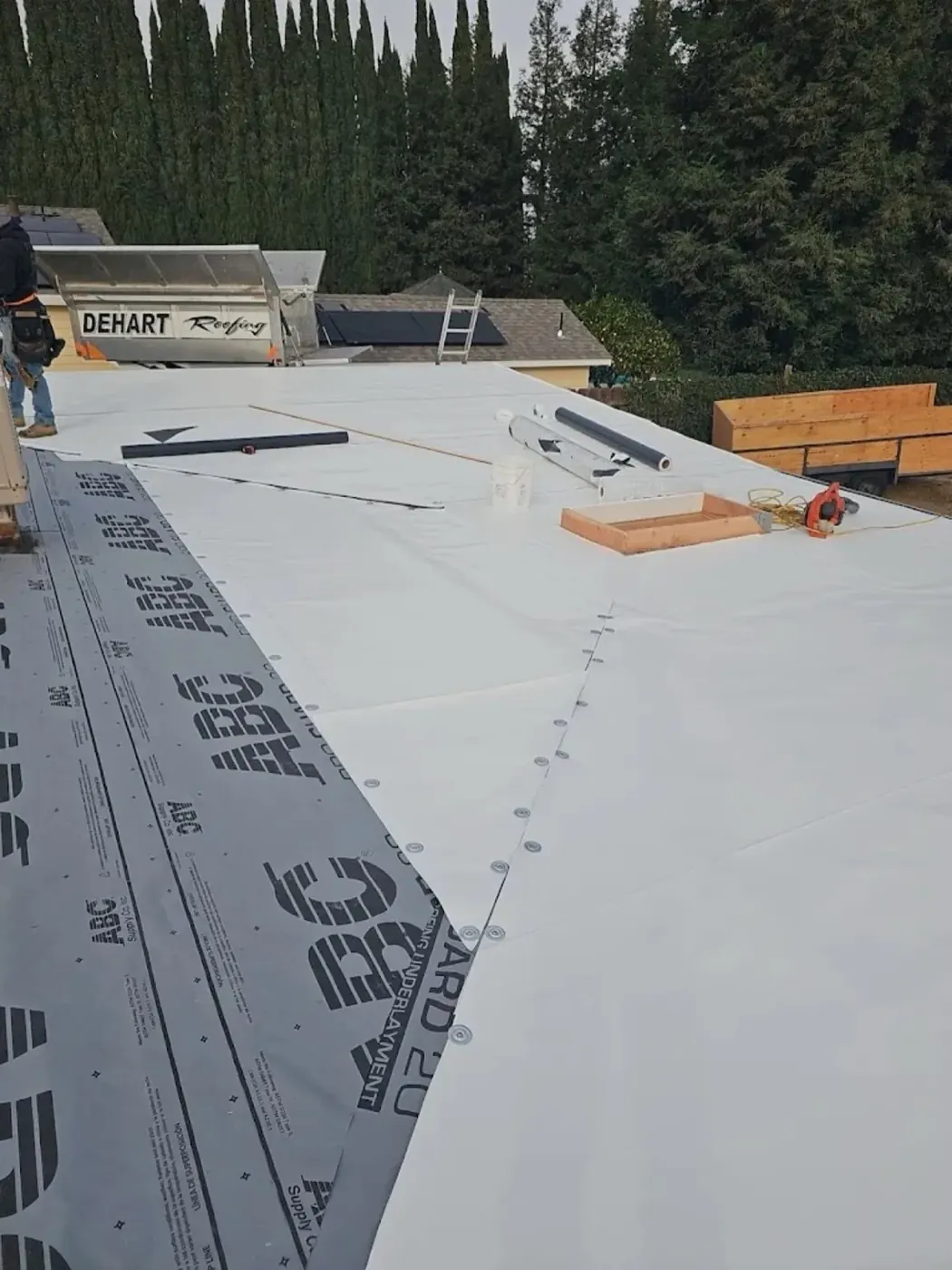
TPO is the top-selling commercial roof in California for a reason. It's white (Title 24 compliant out of the box), heat-welded (single membrane after seam welding), and runs in the budget-friendly middle of the cost range. Service life is 18–25 years in Central Valley heat — less than EPDM in cool climates but the reflectivity earns it back in cooling cost savings. Best for multi-family, retail, warehouse, office, and most low-slope commercial.
Common products: Carlisle Sure-Weld, GAF EverGuard TPO, Versico VersiWeld TPO, Firestone UltraPly TPO, Johns Manville JM TPO. Standard thicknesses: 45-mil, 60-mil, 80-mil. 60-mil is the typical commercial spec.
EPDM (Ethylene Propylene Diene Monomer)
EPDM is synthetic rubber, glued at the seams with tape or contact adhesive. Traditional EPDM is black (absorptive); white EPDM exists but isn't dominant. EPDM is excellent on large, simple roofs because the panels come in widths up to 50 feet, meaning fewer seams. Best for cold-storage facilities, retrofit projects where ballasted installation is feasible, and budget-constrained large roofs.
Common products: Carlisle Sure-Seal EPDM, Firestone RubberGard, Versico VersiGard, Johns Manville EPDM. Standard thicknesses: 45-mil, 60-mil, 90-mil. 60-mil is the typical commercial spec.
PVC (Polyvinyl Chloride)
PVC is the premium single-ply membrane. Heat-welded like TPO, but with better chemical resistance — it handles restaurant grease venting, lab chemical exhaust, and industrial fumes that degrade TPO. Higher cost. Best for restaurants, food processing, hospitals, labs, and any building where membrane chemistry matters.
Common products: IB Roof Systems IB80 / IB50, Sika Sarnafil, Carlisle Sure-Flex PVC, Johns Manville JM PVC, Duro-Last. 50-mil and 80-mil thicknesses. IB and Sarnafil are the long-track-record commercial picks.
Modified Bitumen (mod bit)
Mod bit is asphalt evolved — rubber-modified asphalt in 3-foot-wide rolls, either torch-down applied or self-adhered. Multi-ply systems (two layers) are standard. Budget-friendly, easy to repair, and has a long track record. Best for budget-conscious flat roofs and buildings with shorter holding periods.
Common products: GAF Ruberoid, Polyglass Polyflex, Siplast Paradiene, Johns Manville DynaLastic, CertainTeed Flintlastic. SBS-modified (cold weather) and APP-modified (heat tolerance) flavors — APP is the Central Valley default.
BUR (Built-Up Roofing)
BUR is the original commercial flat roof — multiple plies of asphalt, felt, and gravel built up on site. Heavy. Slow to install. But durable and traffic-tolerant. New BUR installations are increasingly rare; what you typically see is BUR systems being torn off and replaced with TPO or PVC at end of life.
Common materials: Hot-applied asphalt with fiberglass or organic felt plies. Capped with mineral surfaced cap sheet, gravel, or reflective coating. New installs typically use GAF, Johns Manville, or CertainTeed materials.
Standing Seam Metal
Standing seam is the long-term investment. 40–60 year service life, Class A fire rating, fully recyclable. Higher upfront cost. The payoff is the holding period — on a 30-year hold, standing seam often beats every membrane system on total cost. Best for agriculture (Central Valley packing houses, equipment sheds), warehouses, fire-prone areas, and long-hold owner-occupied buildings.
Common products: McElroy Metal Maxima, MBCI BattenLok, Berridge Tee-Panel, Drexel Metals DM-150, Englert S-1500. Typical gauges 22 and 24. Kynar 500 finish for 30–40 year paint warranty. Solar-friendly with S-5! mechanical seam clamps.
SPF (Spray Polyurethane Foam)
SPF is sprayed two-component urethane that creates a seamless, insulated roof in one step. Excellent for buildings with irregular shapes, lots of penetrations, or where insulation needs to be added. Requires recoating with elastomeric or silicone every 8–12 years — with recoating, service life can exceed 30 years; without it, 15–20.
Common products: SWD Urethane, Lapolla FOAM-LOK, Carlisle Spray Foam. Topcoats typically GAF UniTop, Henry 587 Silicone, or GACO S-2000 silicone. Topcoat selection (silicone vs acrylic) is the long-term durability decision.
4. Cost per square foot installed — what to expect on a Central Valley commercial roof
Commercial roofing is priced by the square foot of roof surface, not by the "square" (100 sq ft) used in residential. Here is the realistic 2026 Central Valley installed cost range for each system — what a competitive sealed bid actually looks like.
What's included in "installed" pricing
- Tear-off of existing roof (or recover if code allows)
- Disposal and dumpster fees
- New rigid insulation (polyiso or EPS) to Title 24 minimums
- The membrane or metal panel system itself
- Edge metal, penetration flashings, scuppers or drain rings
- Manufacturer's standard warranty registration
- Permit fees
- Final inspection
What's commonly extra (and should be itemized)
- Deck repair (rotted decking discovered at tear-off)
- Wet insulation replacement (detected by infrared scan)
- Drain replacement or addition
- HVAC curb rebuilding
- Skylight replacement
- Cricket installation behind HVAC units
- Extended manufacturer warranty (15-year, 20-year, or NDL)
Sample project pricing
For context, here's what a 20,000 sq ft commercial roof in the Central Valley typically costs installed in each system:
- TPO: $100,000–$200,000
- EPDM: $90,000–$160,000
- PVC: $160,000–$260,000
- Modified Bitumen: $80,000–$160,000
- BUR: $100,000–$180,000
- Standing Seam Metal: $160,000–$320,000
- SPF: $120,000–$200,000
Three factors move the number outside these ranges: tear-off complexity (multiple layers, asbestos abatement), insulation upgrade (Title 24 increased R-value requirements over time), and access (cranes, lifts, and night work cost more than daytime ground access).
Tax credits, rebates, and incentives that reduce net cost
Three federal and local programs materially reduce the net cost of a commercial roof in 2026. Bring them up with your accountant or CFO before signing.
- Section 179D — Energy-Efficient Commercial Buildings Deduction. Federal tax deduction of up to $5.81 per square foot (2026 IRA-bonus tier) for new construction and major retrofits that meet ASHRAE energy efficiency targets. A 25,000 sq ft warehouse with qualifying insulation + cool roof could deduct $145,000 against income. IRS Section 179D overview.
- Section 48 ITC — Investment Tax Credit (when paired with rooftop solar). 30% federal tax credit on solar PV systems, plus a 10% energy-community adder and a 10% domestic-content adder for buildings that qualify. If you're considering solar, do the solar with the roof — the ITC effectively pays for a significant portion of the roof underneath the panels too.
- MID and TID commercial rebates (Stanislaus County). Modesto Irrigation District and Turlock Irrigation District both run commercial energy-efficiency rebate programs that include cool-roof and added-insulation incentives. Typical rebate dollars are $0.10–$0.50 per square foot of qualifying cool-roof surface plus per-unit rebates on insulation R-value. Application happens before installation — check current programs at mid.org and tid.org.
- PACE financing. Property Assessed Clean Energy financing for commercial buildings attaches the loan to the property tax bill instead of the owner's personal credit. Useful when the owner can't qualify for traditional financing or wants to pass costs to the next owner if the property sells. Note: PACE makes future refinancing harder — lenders treat it as a senior lien.
Combined, these programs commonly reduce net commercial roof cost by 15–30% for owner-occupied buildings that pair a code-compliant roof with eligible insulation upgrade. The IRS Section 179D deduction alone can pay for the cool-roof upgrade premium on a typical 20,000+ sq ft commercial project.
5. Lifespan, warranty, and service life in Central Valley heat
Manufacturer warranty isn't the same as service life. Warranty is what the manufacturer guarantees against defects. Service life is how long the system actually performs in your conditions. Central Valley heat — 100°F+ for 60+ days each summer — ages every membrane system 2–5 years faster than coastal California.
How warranty works on commercial roofs
Commercial manufacturer warranties come in three tiers:
- Material-only warranty (10–20 years). Manufacturer covers defects in the membrane. Labor to replace defective material is on you.
- Total system warranty (15–25 years). Manufacturer covers both material and labor to repair defects, but only if installed by a certified contractor (Master Elite, Platinum, Select, etc.) and registered at completion.
- NDL (No Dollar Limit) warranty (15–30 years). Highest tier — manufacturer covers all repair costs regardless of dollar value. Requires premium installation, third-party inspection, and certified contractor.
Always register the warranty. An unregistered warranty doesn't exist as far as the manufacturer is concerned. Your contractor should provide the registration paperwork and submit it within 30 days of project completion. Ask for a copy of the registration confirmation.
Service life vs warranty — the real numbers
What you can realistically expect from each system in the Central Valley, assuming annual inspections and minor repair work as needed:
- TPO: 18–25 years (warranty often 15–25 years)
- EPDM: 20–30 years (warranty often 20–30 years)
- PVC: 25–35 years (warranty often 20–25 years — service life often exceeds warranty)
- Modified Bitumen: 15–22 years (warranty often 10–20 years)
- BUR: 20–28 years (warranty often 10–20 years)
- Standing Seam Metal: 40–60 years (warranty often 20–40 years — service life dramatically exceeds warranty)
- SPF: 15–20 years without recoating; 30+ years with elastomeric recoating every 10 years
6. California Title 24 + cool-roof requirements
The short version: California requires most commercial low-slope roofs to be reflective (cool roofs). White TPO and white PVC pass automatically. Black EPDM, modified bitumen, BUR, and metal need a reflective coating or finish. The table below shows what each system needs.
The detail: Title 24 Part 6 cool-roof requirements
California Title 24, Part 6 is the state energy code. For commercial roofs, the rules that matter are cool-roof reflectance and insulation R-value.
Cool-roof requirements (low-slope roofs)
Low-slope commercial roofs (under 2:12) in California climate zones 2–15 must meet minimum reflectance and thermal emittance values. Stanislaus, Merced, San Joaquin, and Tuolumne counties are climate zones 12 and 13. The numbers: aged solar reflectance ≥ 0.55 and thermal emittance ≥ 0.75 for new construction; ≥ 0.55 reflectance for re-roofs.
← swipe table to see all columns →
| System | Title 24 status | How to comply |
|---|---|---|
| TPO (white) | ✓ Compliant | Inherently — white membrane meets reflectance |
| PVC (white) | ✓ Compliant | Inherently — white membrane meets reflectance |
| EPDM (black) | ✗ Not compliant alone | Apply reflective coating, or specify white EPDM (limited availability) |
| Modified Bitumen | ✗ Not compliant alone | Specify granulated cool-roof cap sheet OR apply reflective coating |
| BUR | ✗ Not compliant alone | White-coated gravel surface, reflective cap, or topcoat |
| Standing Seam Metal | ↺ With finish | Factory-applied Cool Roof Rating Council (CRRC) coating |
| SPF | ↺ With topcoat | Elastomeric or silicone topcoat meets reflectance |
Insulation R-value requirements
Title 24 minimum R-values for commercial low-slope roofs in climate zones 12–13 (Central Valley):
- R-25 above-deck minimum (most retrofits)
- R-30 above-deck for new construction
- Higher R-values qualify for utility rebates — check with your serving utility. Stanislaus County is served primarily by Modesto Irrigation District (MID) and Turlock Irrigation District (TID), not PG&E. PG&E covers the western edge of the county. Both MID and TID offer commercial energy-efficiency rebate programs that include cool-roof and added-insulation incentives.
For more on California cool-roof requirements, see our Title 24 cool-roof guide.
7. By building type — multi-family, retail, agriculture, light industrial
Generic "best commercial roof" rankings ignore the most important variable: what kind of building is it? Here is the right answer by property type in the Central Valley.
Multi-family
→ TPO
Apartments, condos, townhomes
- Title 24 compliant out of the box
- Heat-welded seams reduce tenant-unit leak risk
- 20-year warranty matches typical hold periods
Retail + restaurants
→ TPO (or PVC for grease)
Strip malls, freestanding retail, restaurants
- TPO for most retail buildings
- PVC where a Type I (kitchen) hood vents grease
- Mod bit only for <15-year holds
Agriculture
→ Standing seam metal
Dairy, almond processing, packing houses, sheds
- 40–60 yr life matches multi-generational holds
- Class A fire rating critical for ag exposure
- PVC for dairy parlors with chemical wash-down
Warehouse + light industrial
→ TPO or metal
Hwy 99 distribution, tilt-up warehouses
- TPO for 15–25 year holds (most owners)
- Standing seam metal for 30+ year holds
- Metal if solar is in the next-10-year plan
Office (low-slope)
→ TPO or PVC
Single-tenant office, professional buildings
- TPO is the default choice
- PVC if Type I kitchen on property
- PVC if roof is amenity / common area
Rooftop solar — by system compatibility
If solar PV is in the next-10-years plan for your building, the roof system underneath matters more than most owners realize. Wrong choice here means $50K–$200K of avoidable racking complexity, warranty conflicts, or roof penetration risk down the road.
- Standing seam metal — the gold standard for solar. Mechanical seam clamps (S-5!, IronRidge XR) attach panels without penetrating the roof. Zero leak risk. Warranty stays intact. Recommended for any building where solar is even possible in the next 20 years.
- TPO — widely compatible with ballast or fully-adhered racking. Single-ply membrane manufacturers (Carlisle, GAF, Firestone) have specific approved racking systems. Penetration-based mounts can be done but require manufacturer-approved flashing details to preserve the warranty. Ballasted systems (no penetrations) work on lower-slope roofs with adequate structural capacity.
- EPDM — compatible but slightly worse than TPO. Black EPDM heats up under the panels, which can shorten membrane life. White EPDM avoids this.
- PVC — compatible with ballast, fully-adhered, and manufacturer-approved penetrated racks. Similar to TPO. Verify racking choice with both the membrane manufacturer and the racking manufacturer.
- Modified bitumen, BUR, SPF — possible but messy. Penetration mounts are the norm. Each penetration is a future leak risk. Best to reroof before adding solar.
Sequencing matters. If your roof is 15+ years old and you're planning solar, reroof first. Solar panels typically have 25-year warranties; installing them on a 10-year-remaining roof means tearing the array down to replace the roof underneath. The labor to remove and reinstall a 50kW commercial array costs $15,000–$40,000 — significantly more than reroofing on the front end.
The federal Section 48 Investment Tax Credit (30% base + 10% energy-community adder + 10% domestic-content adder) effectively reduces solar PV cost by 30–50% for qualifying buildings. NEM 3.0 changed the economics on grid-tied solar — on-site consumption beats export. Battery storage qualifies for ITC too.
8. Picking a commercial roofing contractor — what's different from residential
The CSLB C-39 roofing license is required for any California roofing project over $500, commercial or residential. But the C-39 alone doesn't make a contractor commercial-capable. Three additional qualifications matter on commercial work.
Manufacturer system certification
Each major commercial membrane manufacturer (Carlisle SynTec, GAF, Firestone, Versico, IB Roof Systems) has installer certification tiers — basic certified, Master/Elite, NDL-approved. NDL warranties only ship with installers certified at the highest tier. If you want a 20-year NDL warranty on your TPO system, the bid has to be from an NDL-approved Carlisle installer. Ask for the certification letter; don't take the contractor's word.
Bonding capacity
Commercial projects over $100,000 typically require contractor performance bonding. The contractor's bonding capacity caps the size of project they can take on. For projects over $250,000, ask the contractor's bonding agent to confirm capacity. A contractor with $250K capacity can't credibly bid your $750K warehouse.
Scheduling flexibility
Most commercial roofing has to happen around the tenant's business hours. Restaurants want night work. Retail wants Sunday work. Warehouses want weekday off-shift work. Multi-family wants tenant-noticed work. Ask how the contractor handles your timing constraints. A residential-only contractor often can't staff night shifts.
Verify the basics
- License: cslb.ca.gov — verify C-39 license is active and in good standing
- Workers' comp insurance: Ask for the certificate of insurance (COI) before work starts
- General liability: Minimum $2M aggregate for projects over $100K
- References: Three completed commercial projects in the past 24 months, with property owner contact info
- Site visit before bid: Any contractor who bids without walking your roof is guessing. Decline that bid.
9. Permits, code, and inspections in Stanislaus County
Commercial roofing permits in the Central Valley vary by jurisdiction. Here's what you can expect.
Permit costs and authority
- Modesto: Modesto Building Safety Division. Commercial roof permits typically scale with project valuation, $400 minimum. Expect roughly $500–$1,200 for a $200K project. Confirm current fee schedule with the building department before contract signing.
- Turlock: Turlock Development Services. Similar fee schedule. Expect $500–$2,000 depending on valuation.
- Ceres: Ceres Building Department. Smaller jurisdiction, faster turnaround. $400–$1,500 typical.
- Unincorporated Stanislaus County: Stanislaus County Building Inspection (1010 10th Street, Modesto). $500–$2,500 typical for commercial.
- Adjacent counties: San Joaquin (Manteca, Lathrop, Stockton), Merced (Atwater, Merced, Livingston), Tuolumne (Sonora) all have their own permit offices and fee schedules.
For more, see our Stanislaus County permit guide — written for residential but the permit office and process is the same for commercial.
What inspectors check on a commercial re-roof
- Tear-off completeness if multi-layer existing system
- Deck condition — replace soft or rotted decking before new system goes on
- Insulation R-value — meets current Title 24 minimum for climate zone
- Membrane attachment — fastener pattern, plate spacing, or adhesive coverage to manufacturer spec
- Flashings — penetrations, walls, edges all flashed per manufacturer detail
- Drains — sumped properly, strainer present, scupper height correct
- Cool-roof reflectance — verified at final via product CRRC label or applied coating
CALGreen and energy reach codes
Stanislaus County jurisdictions have not adopted aggressive energy reach codes beyond Title 24 (as of 2026). If your building is in San Joaquin, Sacramento, or Bay Area jurisdictions, check for local reach codes that may require higher insulation, additional solar-readiness, or electrification provisions on commercial roof replacements.
10. Maintenance and service-life planning
Every commercial roof system needs annual inspection. Reactive maintenance (waiting for leaks) costs 3–6x what proactive maintenance costs. The National Roofing Contractors Association (NRCA) publishes commercial roof maintenance standards that most carriers and warranty manufacturers accept as best practice. Here is what an actual commercial roof maintenance program looks like.
Annual inspection items
- Walk the entire roof field looking for membrane damage, blisters, splits, or seam failures
- Inspect every penetration flashing for separation or cracking
- Inspect all edge metal for fastener back-out or sealant failure
- Inspect drains, scuppers, gutters — clear debris
- Check ponding patterns (water standing more than 48 hours after rain is a problem)
- Note any rooftop equipment changes since last inspection
- Photograph and write up a condition report
System-specific maintenance triggers
- TPO/PVC/EPDM: Seam re-welding at year 8–12 if seams show stress. Topcoat re-application not standard but extends life on aging membrane.
- Modified Bitumen / BUR: Recoat with reflective elastomeric every 7–10 years — doubles remaining service life.
- Standing Seam Metal: Fastener tightening at year 15. Sealant refresh at penetrations every 10 years. Repaint at year 25 if finish chalking.
- SPF: Recoat with elastomeric or silicone every 8–12 years — non-negotiable. Without recoating SPF fails fast.
The cost of skipping maintenance
A 25,000 sq ft commercial roof with deferred maintenance for 8–10 years typically needs $40,000–$120,000 of catch-up repairs that should have been $5,000–$15,000 spread over the period. The math is brutal: annual inspections at $300–$800 per visit and minor seam/flashing repairs at $1,500–$5,000 per year is dramatically cheaper than the alternative.
11. Insurance, FM Global ratings, and commercial roof specification
Commercial property insurance drives 30%+ of roof system specification on insured commercial buildings. If your carrier requires a specific wind uplift rating or hail rating, that requirement frequently dictates the system choice before cost or aesthetic enter the discussion. Here is what to expect.
FM Global wind uplift ratings
FM Global is the dominant commercial property insurance carrier in the U.S. industrial and Fortune-500 market. Their roof ratings (published in FM Approvals Standard 4470 and related) have become the de facto specification standard even for non-FM-insured buildings. The two ratings that matter most:
- FM I-90 — wind uplift resistance up to 90 psf. Standard for most commercial buildings in low-to-moderate wind exposure.
- FM I-105 — wind uplift resistance up to 105 psf. Required by FM Global for properties in higher exposure or under specific scoring criteria.
- FM I-120 and higher — for hurricane and high-wind coastal areas. Generally not required in Central Valley.
What this means for Central Valley commercial: most carriers accept FM I-90 as the minimum. A commercial property at the edge of an open-field exposure (Hwy 99 distribution centers, agricultural buildings) may be required to spec FM I-105. Verify with your carrier before signing a contract — an under-rated installation can affect coverage at claim time.
Class 4 hail-rated systems and the California insurance discount
UL 2218 Class 4 impact rating qualifies a roof system for a homeowner's or commercial property insurance discount in most California carriers. Discount values: typically 5–15% off the wind/hail portion of premium, which on a $200,000-dwelling commercial property can be $400–$1,500 per year. Standing seam metal earns Class 4 by default. Some TPO, PVC, and modified bitumen systems are also Class 4 rated — ask for the UL 2218 documentation from the manufacturer before signing.
ASCE 7 wind zone for Stanislaus County
The American Society of Civil Engineers (ASCE 7) sets baseline wind-load design standards used by California building code. Stanislaus, Merced, and San Joaquin counties sit in Wind Zone 1 (V-ult = 95 mph, Risk Category II) — the lowest exposure category in California for most buildings. Sonora and Tuolumne foothills are also Wind Zone 1 but with elevated topographic exposure. ASCE 7 wind values inform the FM uplift rating selection: a Wind Zone 1 building in moderate exposure can usually meet code with FM I-90; a building on an exposed bluff or open ag site may need FM I-105.
Carrier-specific commercial requirements
Common carrier-specific notes we see in Central Valley commercial:
- FM Global requires their own approved installer list and FM-approved insulation, membrane, and fasteners. Non-FM contractors can quote, but the building loses FM rating.
- Travelers typically accepts FM I-90 minimum and requires manufacturer's NDL warranty on projects over $250,000.
- Liberty Mutual often requires Class 4 hail rating on commercial properties in expanded brush zones.
- Zurich requires manufacturer's installer certification at NDL tier for buildings over 50,000 sq ft.
- Smaller California regional carriers typically accept ASTM E108 Class A fire rating + Title 24 compliance as adequate spec.
Filing commercial roof claims
If your commercial property has roof damage from a covered peril, the claim process mirrors residential with some commercial-specific twists: business interruption coverage may apply, multi-tenant buildings have separate per-unit considerations, and FM-rated buildings often require FM-certified contractors for repairs to maintain rating. For the full residential claim playbook (which translates closely to commercial single-occupant buildings), see our California Roof Insurance Claim Guide.
Commercial roofing glossary
TPO
Thermoplastic Polyolefin. Heat-welded white single-ply membrane. Most common commercial roof in CA.
EPDM
Ethylene Propylene Diene Monomer. Synthetic rubber membrane, glued seams, typically black.
PVC
Polyvinyl Chloride. Premium single-ply membrane with superior chemical resistance.
Modified Bitumen
Rubber-modified asphalt in rolls. Torch-down or self-adhered. Budget flat-roof option.
BUR
Built-Up Roofing. Original flat-roof system: alternating asphalt and felt plies with gravel cap.
SPF
Spray Polyurethane Foam. Sprayed-in-place insulating roof system. Requires periodic recoating.
Standing seam metal
Vertical-rib metal panels with concealed clip fasteners. 40–60 year service life.
Title 24
California's energy code requiring cool-roof reflectance and minimum insulation R-values.
CRRC
Cool Roof Rating Council. Third-party body that certifies cool-roof reflectance.
NDL warranty
No Dollar Limit. Manufacturer warranty covering all repair costs regardless of value.
Recoat
Applying a new top layer (elastomeric or silicone) over an existing roof to extend service life.
Tear-off vs recover
Tear-off removes all existing layers. Recover installs new over existing. CA code limits to 2 total layers.
Wet insulation
Water-saturated insulation under the membrane. Detected by infrared scan. Must be replaced.
Ponding water
Standing water on the roof more than 48 hours after rain. Damages most membrane systems.
Cricket
A small sloped roof structure behind HVAC units or chimneys to divert water around the obstruction.
Scupper
Drainage opening through a parapet wall that lets water escape the roof.
A note on where DeHart fits for commercial work
DeHart Roofing has installed commercial roofs across Stanislaus County since 1975. We're certified by Carlisle SynTec, GAF, and Owens Corning for commercial systems. Our crews install TPO, PVC, EPDM, modified bitumen, BUR, standing seam metal, and SPF — meaning we can recommend the system that fits your building, not the one system we know how to install.
What we'll do for a Central Valley commercial property at no charge:
- Free on-site condition assessment with photos and a written report
- Infrared moisture scan if requested (detects wet insulation under the membrane)
- Service-life ranking with next 2–5 years of maintenance needs
- System recommendation matched to your holding period and building type
- Bonded for projects up to $1M; certified for NDL warranty installations
If you're past the research stage and want a sealed bid for a specific project, request a commercial roof quote here or call (209) 667-7737.
Related reading: Residential roof replacement guide · Commercial roofing services · Flat roofing · Metal roofing · Roof coatings · Title 24 cool-roof guide · Flat vs pitched cost · California roof insurance claim guide · Stanislaus permit guide · Modesto · Turlock · Ceres
Frequently asked questions
What is the best commercial roofing system for the Central Valley?
How much does a commercial roof cost in the Central Valley?
Does my commercial roof have to comply with California Title 24?
Should I replace my commercial roof or just recoat it?
What's the difference between TPO and EPDM?
How long does a commercial roof last in Central Valley heat?
Do you offer commercial roof financing in California?
Can I get a commercial roof inspection without a sales pitch?
Commercial property in the Central Valley? Get a free condition report.
Bonded. Insured. C-39 Licensed. Carlisle / GAF / Owens Corning certified.